October 2025 - V1.14.0
✨✨✨ The most recent release brings some urgent new features and bug fixes that should enhance your experience. Check out what’s changed.
🚀 Highlights
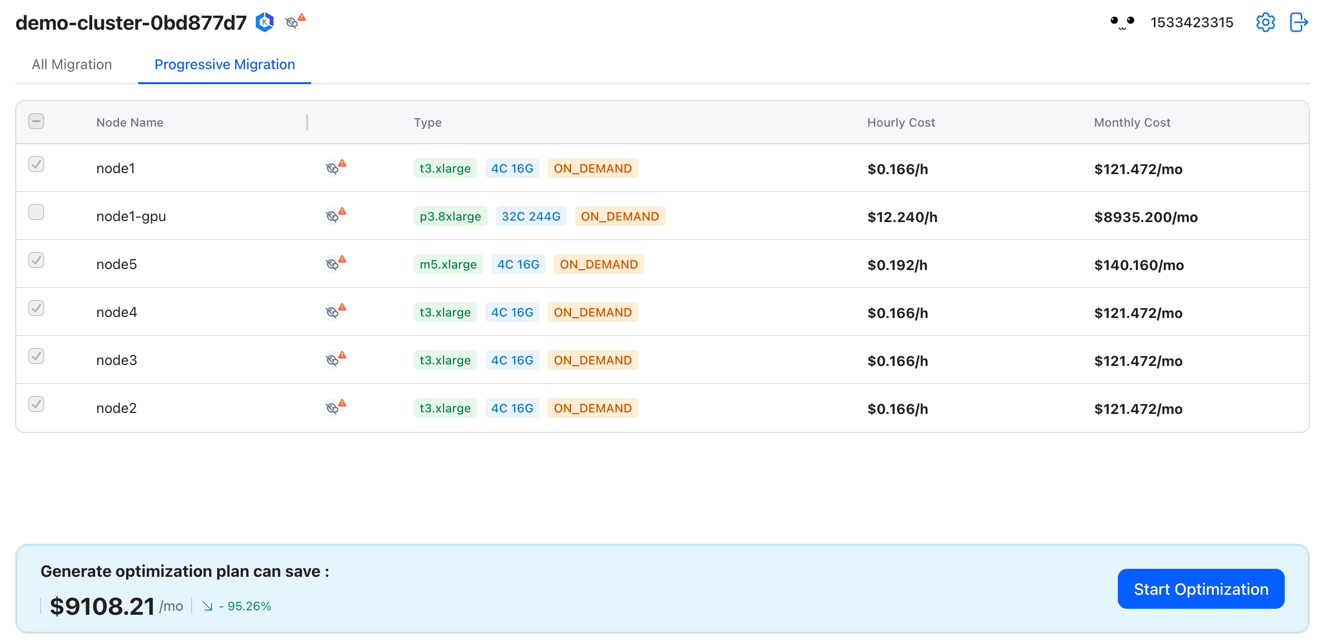
Progressive Migration
CloudPilot AI now supports node-level gradual migration, allowing users to progressively bring existing nodes under CloudPilot AI management without migrating all nodes at once.
- Enables gradual node onboarding into CloudPilot AI management based on business and stability needs, following the pace of the PoC.
- Supports maintaining normal operation of existing nodes during the migration process to avoid business interruptions.
Workload Autoscaler
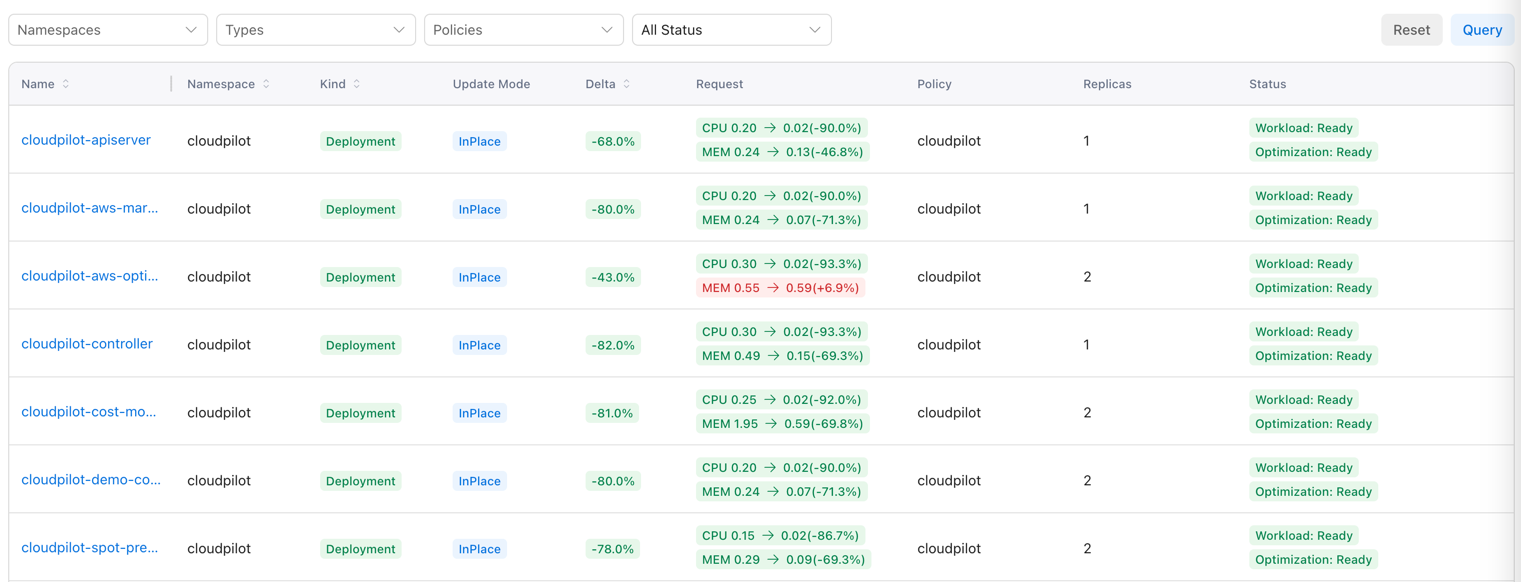
CloudPilot AI now supports the Workload Autoscaler component, which automatically analyzes each workload’s actual resource usage and dynamically adjusts its Requests and Limits configurations to achieve higher resource efficiency and cost savings.
- Automatically adjusts workload Requests and Limits based on real resource usage.
- Provides flexible configuration options to avoid updates during peak hours and minimize business impact.
- Supports multiple update modes, including InPlace, to accommodate different business needs.
- Offers powerful visualization to track each workload’s resource usage and adjustment history.
- Supports multi-select and bulk operations, enabling one-click optimization for all workloads.
Pod Mutation
CloudPilot AI introduces the new Pod Mutation feature, allowing users to select specific groups of workloads and inject custom configurations to optimize their scheduling and operation on Spot instances.
- Supports selecting a group of workloads via the PodMutation CR and injecting specific configurations.
- Supports injection of configurations such as Node Affinity, Tolerations, Labels, and Annotations.
- Enables workload-level gradual migration, allowing workloads to be progressively brought under CloudPilot AI management.
apiVersion: agent.cloudpilot.ai/v1alpha1
kind: PodMutation
metadata:
  name: gradual-rebalance
spec:
  workloadSelector:
    namespaces:
      - test
    kinds:
      - Deployment
  mutationAdd:
    tolerations:
      - key: "cloudpilot.ai/gradual-rebalance-only"
        operator: "Exists"
    nodeSelector:
      "node.cloudpilot.ai/managed": "true"
Terraform
CloudPilot AI now supports installation and configuration management via Terraform, making it easier for users to integrate CloudPilot AI into their existing Infrastructure as Code (IaC) workflows.
- Provision and manage EKS clusters with CloudPilot AI integration
- Automated agent and rebalance component installation
- Node pool and node class management (including custom Karpenter JSON)
- Workload cost optimization (rebalance, spot-friendly, min non-spot replicas)
- Seamless AWS CLI and kubeconfig integration
⚙️ Enhancements
- The Node Repair feature will now remove some Pods from a node before removing the node itself, reducing the impact on workloads.
- Optimized the Simulation computation logic, significantly reducing Agent CPU usage after a Rebalance is completed.
- Optimized the issue where, in some cases, the Optimizer might evict interrupted Spot nodes too slowly due to PDB constraints.
🛠️ Bug Fixes
- Fixed an issue where the Workload Diversity feature could, in some cases, ignore existing OnDemand nodes and cause Pods to be rescheduled.
- Fixed a caching latency issue in the Webhook component under certain conditions.
- Fixed the display of Zone-related information in the Demo cluster.
- Fixed inaccurate calculations for Non-Spot Pods of Workloads in some cases.
- Fixed an issue where certain components could prematurely perform operations such as Evict during the Rebalance process.
- Fixed synchronization issues for cluster-related information under certain conditions.
These updates further improve CloudPilot AI’s overall reliability and user experience. For questions or support, join our Slack community
Stay tuned for more updates! 🚀